Inner.U Migration
A cognitive-bias evaluation that became the design language for a shipped funnel.
The Handel Group came to me with two brands, one funnel running between them, and a handful of websites they admired. They were smart people, and I'll admit I was a little intimidated. So instead of walking in with opinions, I walked in with a framework, and that framework ended up becoming the design language for the redesign.
- Role
- Consulting design lead and methodology architect for The Handel Group
- Timeline
- Multi-week brand migration consult
- Stack
- Coglode Cognitive Nuggets, Yu-kai Chou's Octalysis framework, Figma
- Outcome
- Mid-fi wireframes adopted. Inner.U redesigned and shipped, with HG Life's free content folded into its free tier.

The brief
The Handel Group had two web presences doing two different jobs. HG Life was the B2B and content-marketing surface, and Inner.U was the self-serve coaching platform that all that content was meant to point people toward. The two had grown up separately and looked like it. The company wanted to bring them together visually, keep the funnel mechanics intact, and make the self-serve flow a lot lighter to move through.
The contract was for mid-fidelity wireframes. The team arrived with several sites they liked and was honest that they weren't sure how to get from inspiration to direction. That's more common than people let on. A folder of sites you like is a mood, not a plan.
Bringing backup
I'd just come off a six-month deep dive into gamification, specifically Yu-kai Chou's Octalysis framework and Coglode's library of cognitive-bias "nuggets." Coglode catalogs behavioral biases along with patterns for putting them to work. Octalysis maps human motivation into eight core drives: Meaning, Empowerment, Social Influence, Ownership, Scarcity, Unpredictability, Avoidance, and Accomplishment. I'd been waiting for the right project to try them on, and this was it.
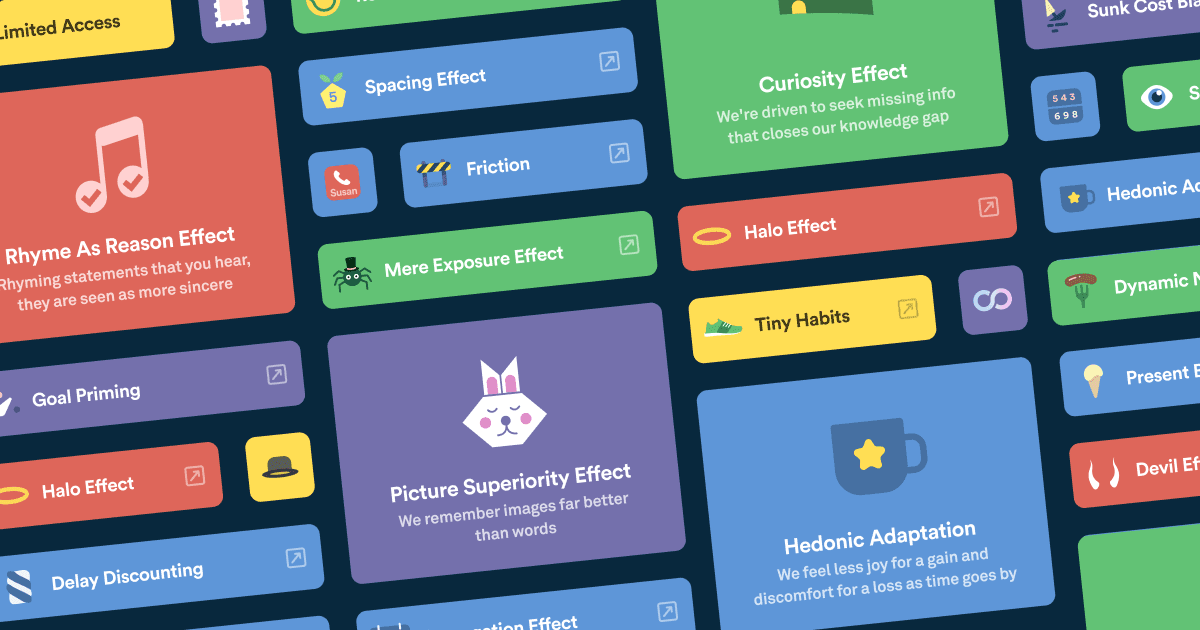 coglode.comCoglodeGet bite-size behavioural insights, learn methods and apply them artfully to solve your problems with greater impact
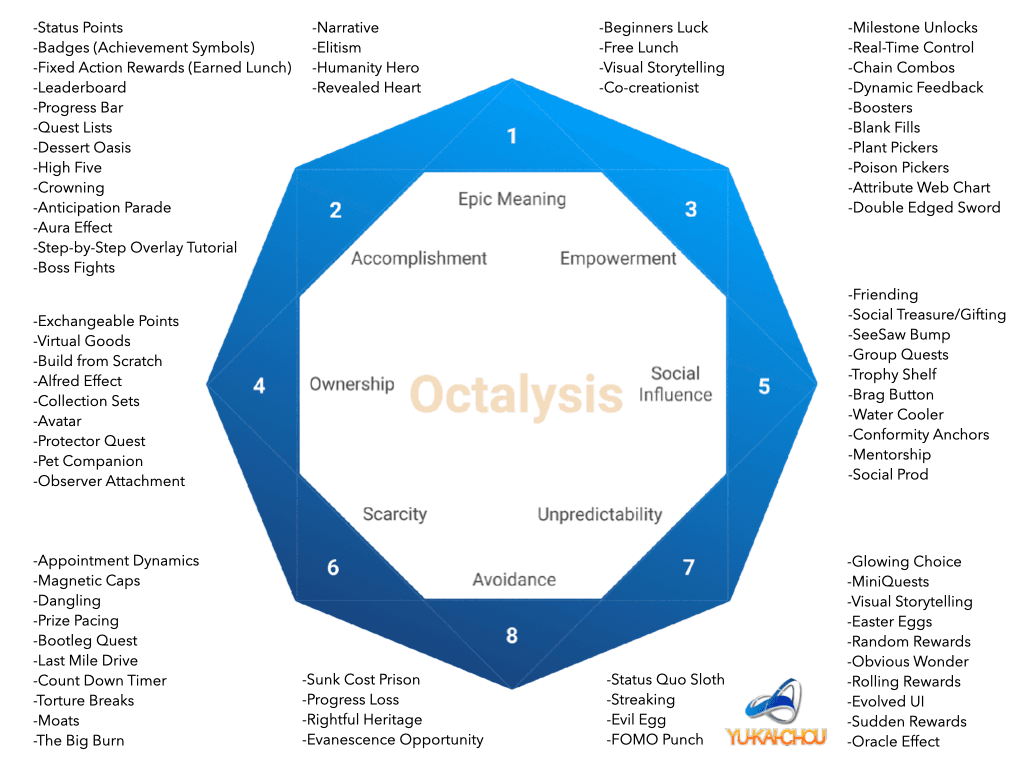 Yu-kai ChouThe Octalysis Framework: 8 Core Drives of GamificationOctalysis is Yu-kai Chou's gamification framework, built on 8 Core Drives of human motivation. Used by Google, Tesla, and LEGO. Cited in 3,700+ studies.
The approach was itself a bit of a trick. Leaning on a recognized methodology is the Authority bias at work, grounding judgment in something other than my taste. Yes, I used a cognitive bias to sell a cognitive-bias evaluation. I'm aware. But walking into the room with a named framework behind every observation turned "do you like this?" into "is this the mechanic we want here?" and that's a much better conversation to be having.
The evaluation
I took full-page screenshots of every funnel they admired, plus three of my own that I thought were closer to what they were actually trying to do. Then I went section by section and tagged every block on every page with the bias it was using. Social Proof here, Anchoring there, the Spacing Effect across a testimonial layout, Risk Aversion in a pricing call to action, Endowed Progress in a program intro.
I did the same thing to Inner.U and HG Life as they stood at the time, so every comparison was apples to apples. What the analogs were doing, what the client was already doing, and where the gaps were.
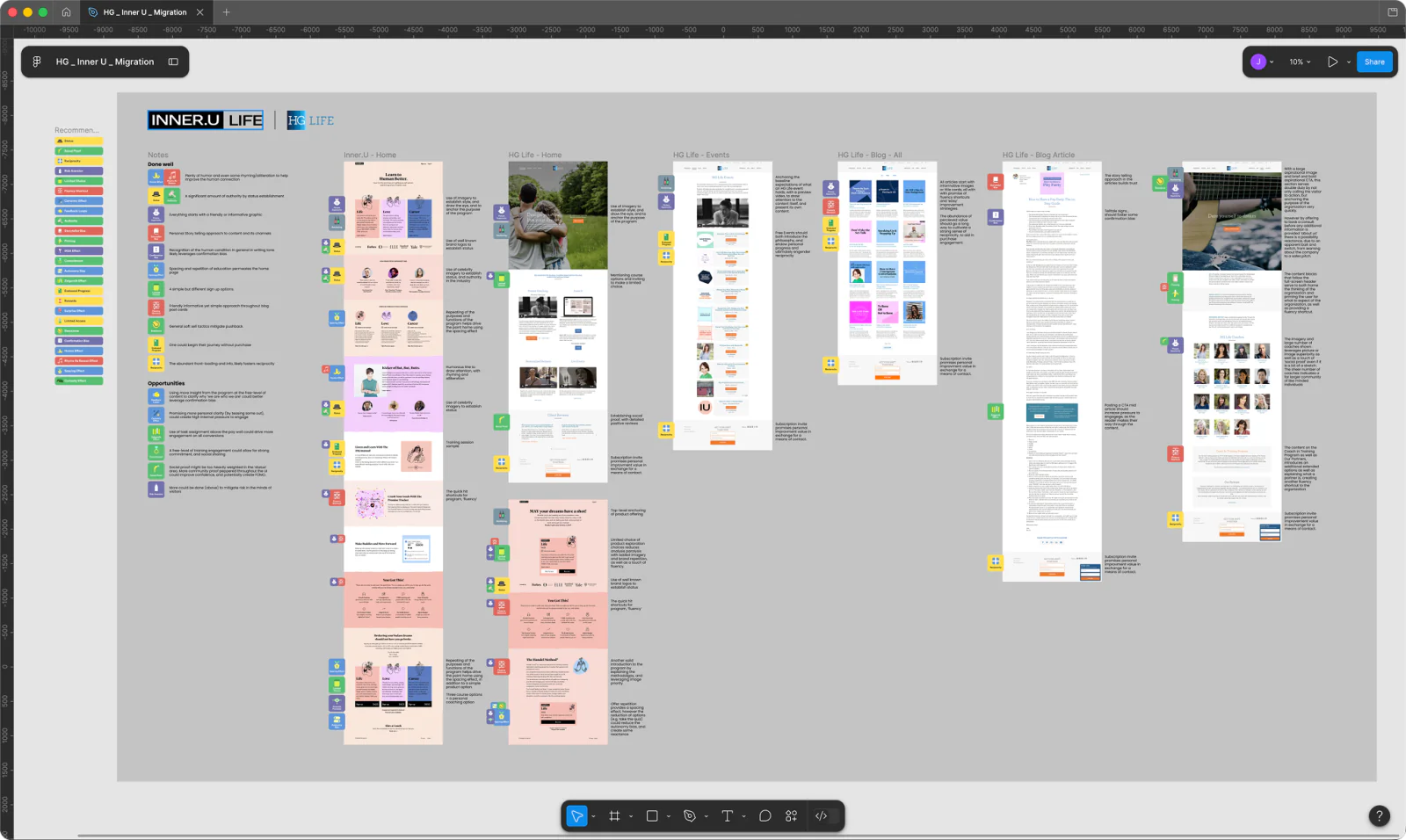
When we presented it, the client had never seen anything quite like it. Neither had I, but I didn't let on. After that first session they asked if we could record the rest of the engagement so the conversations could be shared around the company.
From evaluation to wireframes
Next I pulled the strongest sections apart into very low-fidelity wireframes, kept the bias chips hanging off every block, and rebuilt the funnel from the winners. The wires weren't meant to look like anything yet. They were just structural choices with their reasons attached, which made every decision in the room traceable. We're using Endowed Progress here because it worked on a competitor's onboarding. We're using Limited Choice on pricing because too many options were causing analysis paralysis on the existing page.
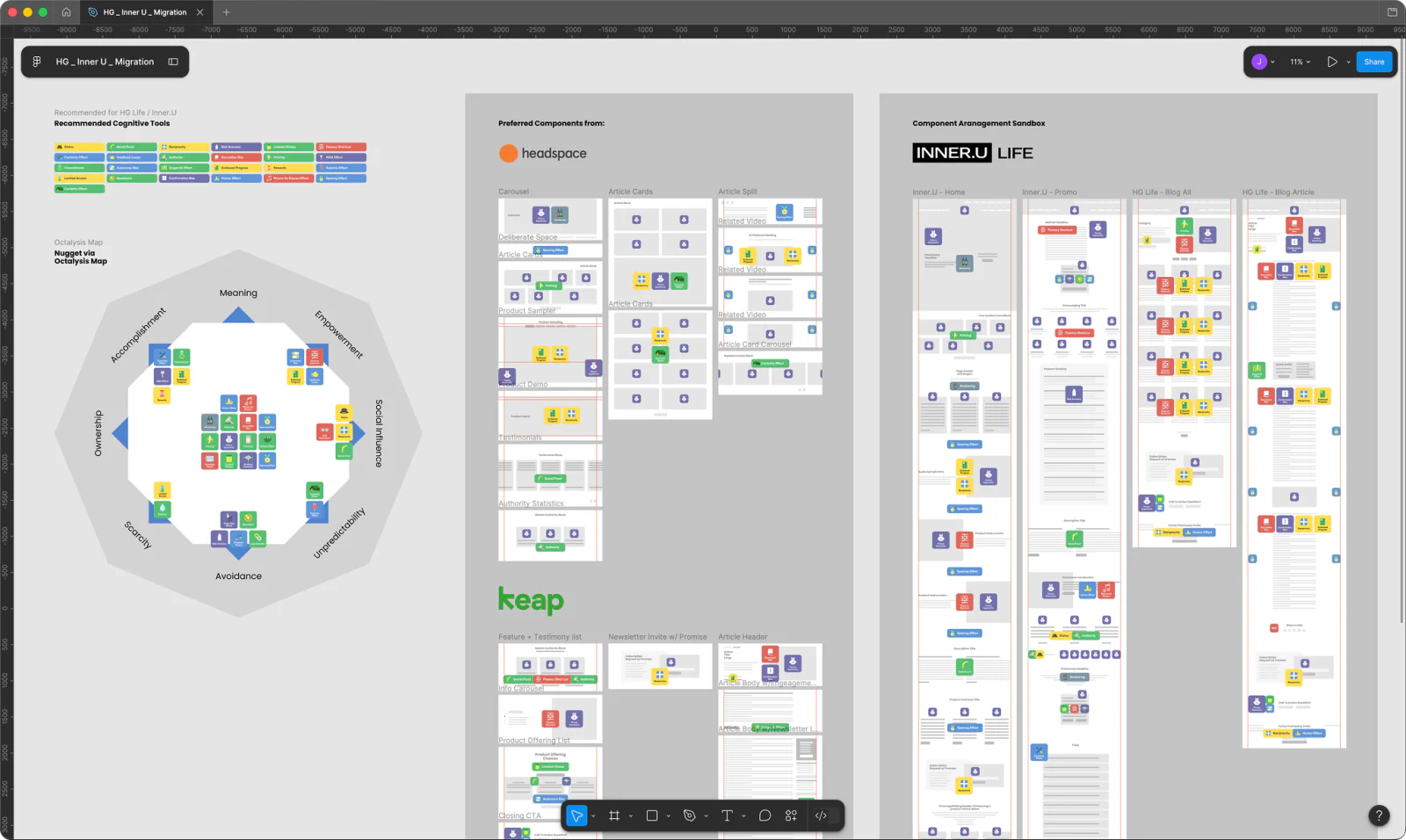
Once the client settled on which wires to carry forward, I mapped the surviving nuggets onto the Octalysis octagon as a last gut check. The question Octalysis answers is whether you're pushing the right human buttons at the right point in the journey: Meaning early, Accomplishment in the middle, Social Influence in the proof, Scarcity at the close. Laid out that way, it was easy to spot motivational holes the bias work hadn't turned up on its own.
The room kept getting bigger
The audience grew over the course of the engagement, from a small working group, to recorded sessions, to a packed final review. By the end, members of the marketing team had asked to sit in, partly to see what we'd been up to and partly to grill us on it. I'll take that kind of room any day. The approach held up under questioning because every section had a "because" attached, and none of them were "because it looks nice."
What shipped
The wireframes were delivered and adopted. Inner.U was redesigned and built to spec, and it's live today at inneru.coach. HG Life's free content moved into Inner.U's free tier, so the funnel points at the self-serve platform the way the strategy intended.
HG Life's standalone marketing site stayed in its older treatment. That was the part of the plan the team chose not to take all the way, and by the end of the engagement we'd half expected it. What landed, landed.
The part I'm proudest of is what's happened since. A couple of years on, the changes the team has made are nearly invisible against the original. The habit of giving every section a bias and a reason turned out to be sturdy enough that new updates inherit it without anyone having to think about it. That tells me the framework held up as a way of building, and not just as a way of presenting.
Why I'd point to this one first
The bias map and the Octalysis check weren't process for the sake of process. They changed what the room was arguing about, from preference to mechanism. Nobody had to win a taste contest, because every section already knew what it was supposed to do.
I should be honest about why we worked that way, though. We didn't have visitor or engagement data to build against, and we weren't going to get any, so we needed some other basis for making decisions and defending them. The frameworks were that basis. They were the best string I had to pull, and I pulled it because I cared about the brand. But a well-reasoned assumption is still an assumption. Given my druthers, I'd ask for data first, and I wouldn't call the work done until the numbers agreed with us. I'm a trust-but-verify guy, not someone who sits around playing Coglode tarot with digital products.
All in all, I'd have loved the runway to stick around a while, watch the meters, and tune the engine we built against real engagement, to make sure we were pushing the right buttons and not leaving opportunities on the floor. Even without it, this is still the client engagement I'd point to first, and one of the most rewarding of my career.