Redacted: Disclosure Unlikely
A complete physical product, storefront, and content channel shipped for $1,470 against a ~$180,000 replacement cost.
Redacted is a satirical trading card game about UFO disclosure. I built it by myself, over about two years of evenings, and it cost me $1,470. A studio would have needed something like $180,000 to commission the same box. This is how that happened, and also where that number stops telling the whole truth.
- Role
- Creator, art director, and every other seat
- Timeline
- ~24 months of evenings, Summer 2024 to August 2026
- Stack
- Manus and Grok (research, rules v1), MidJourney and ChatGPT (art), Fable 5 (rules v2 and self-play balancing), Affinity then InDesign (data merge), Claude Code (feedback terminal), Sketch and Cursor with Grok 4.6 (storefront), DaVinci Resolve and Higgsfield (video), Stripe
- Team
- Me, evenings, plus my wife, who supplied the envelopes and the distribution idea
- Outcome
- Live. Pre-orders open at redacted.cx since August 25, 2026, shipping December 1.

Where this started
My brother said, half-drunk and apparently sincere, "Greer needs a trading card." A light went on.
We're both former X-Files obsessives, and we'd been circling the same question through all the recent UFO and UAP disclosure noise: where is Steven Greer in all this? The man had been pushing disclosure for decades, and the Tom DeLonge era seemed to eclipse him almost overnight. Hence the trading card.
The next morning I opened Manus, which I was using for client work every day at the time, and pitched it the idea as a research brief. Was this doable, where were the legal landmines, and was there a real game hiding inside the joke? Manus came back with the bones of a full trading card game. When I handed my brother a finished deck months later, he had no memory of the conversation. I suspect drinks were involved. He loved it anyway.
What Redacted actually is
Fifty cards in the starter set across six categories, plus a ten-card expansion. The names are fake the way Garbage Pail Kids names were fake, and the art is openly based on exactly who you'd guess.
The mechanic doing most of the work is credibility. Every card costs credibility to play, some cards swing a public-opinion meter, and a "Mainstream Authority" tier kicks in once you cross a threshold. The joke writes itself when the character card modeled on the Ancient Aliens guy with the hair comes in at a low credibility cost and an equally low starting credibility. Anyone who knows the lore laughs. Anyone who doesn't picks it up in two rounds.
The satire is non-partisan on purpose. I've handed decks to people on opposite ends of the political spectrum, and they've enjoyed it for the same reason: government opacity around this stuff is one of the few things both sides are genuinely sick of. The deck makes fun of the discourse, not the audience.
Two years, out loud
Mostly two-hour blocks, a few nights a week. Call it 500 to 700 hours of my own time. Here's roughly where it went.
- Summer 2024. Drinks, a joke, no project yet.
- Fall and winter 2024. Product research with Manus and Grok: feasibility, legal exposure, and whether there was a real game in the premise.
- Winter 2024–25. Rules v1, same pair. I know how to design cards. I have never known how to balance a cost curve, and ten years ago that gap would have killed this project outright.
- Winter and spring 2025. Card art, in MidJourney and ChatGPT, from bed on a laptop while our newborn was still sharing the room.
- Spring 2025. Card design v1 in Affinity, after several false starts on direction.
- Summer 2025. Data merge v1 and the beta print run. Every print file generated at once, ten decks ordered from MakePlayingCards.
- Late summer 2025. Betas shipped, in plain envelopes, with a rule sheet and a link to a feedback terminal.
- Fall 2025 through spring 2026. Parked for feedback. I built SMC in the gap.
- Early summer 2026. Rules v2. Fable 5 rewrote the mechanics and balanced them against itself.
- Mid summer 2026. An online version of the game, and the closest I came to quitting.
- August 2026. The pivot, then the drop. New print files, a new storefront, video, Stripe, and doors open on the 25th.
The manila envelope
My wife came home from an ordinary post office run with a stack of padded envelopes and said, "you could send these out in these. Nondescript, no markings." It was close enough to my birthday that I've always quietly filed it as a present.
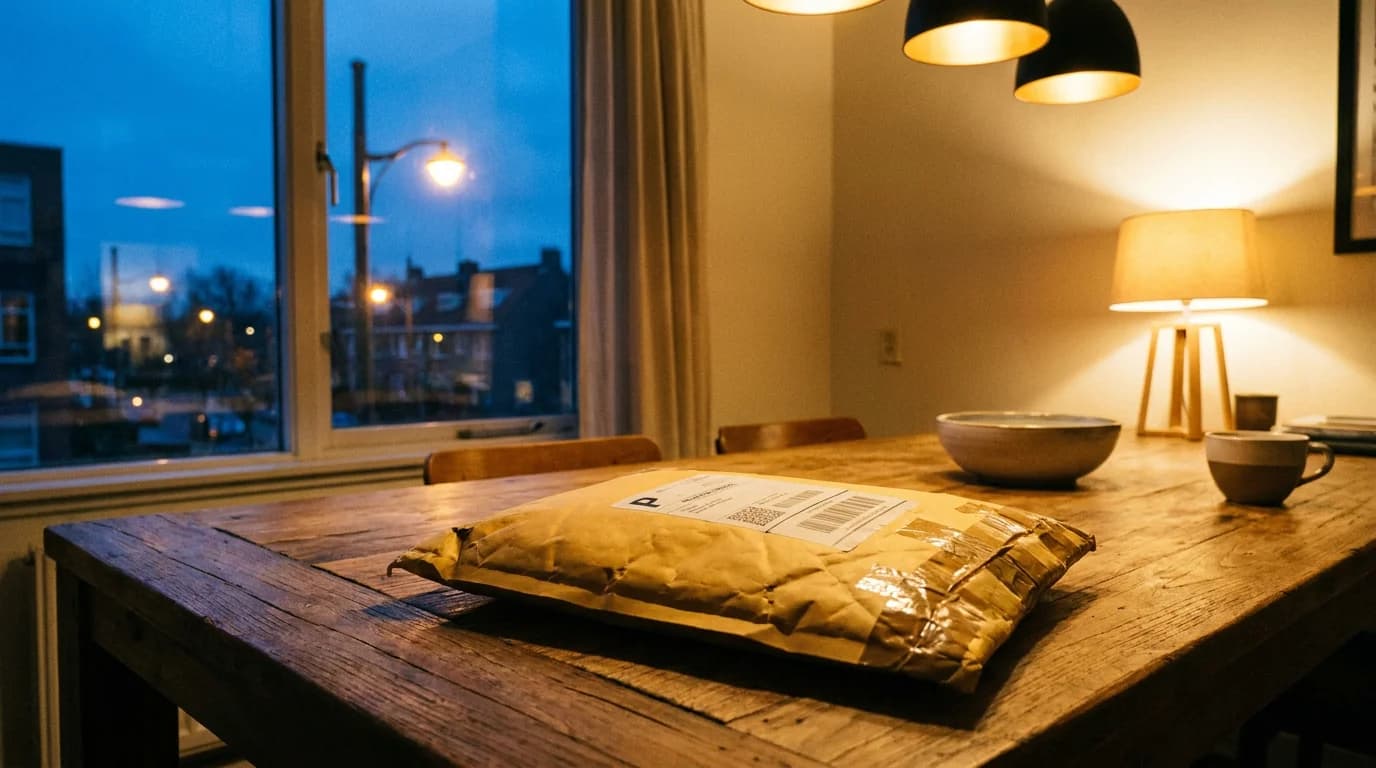
I'd been putting together the first batch of beta packets, a starter deck, a rule sheet, and a deliberately shady letter written as if from an insider who didn't want to be named, when the envelopes turned up. She hadn't gone looking for them. The project just crossed her mind while she was standing in line, and that's the part I actually care about. It was the first sign this thing had become interesting to somebody other than me.
The whole distribution story snapped into place around those envelopes. Mailers go out plain, with no branding, so getting one feels closer to receiving a leak than a launch. Co-conspirator credit goes to my wife, and she's the only line in the budget below that isn't a number.
The terminal
The beta feedback site is an 80s CRT mock-up at redacted-2393-fwiw.netlify.app. Claude Code built the look in one shot, in an afternoon, and that afternoon changed how I work.
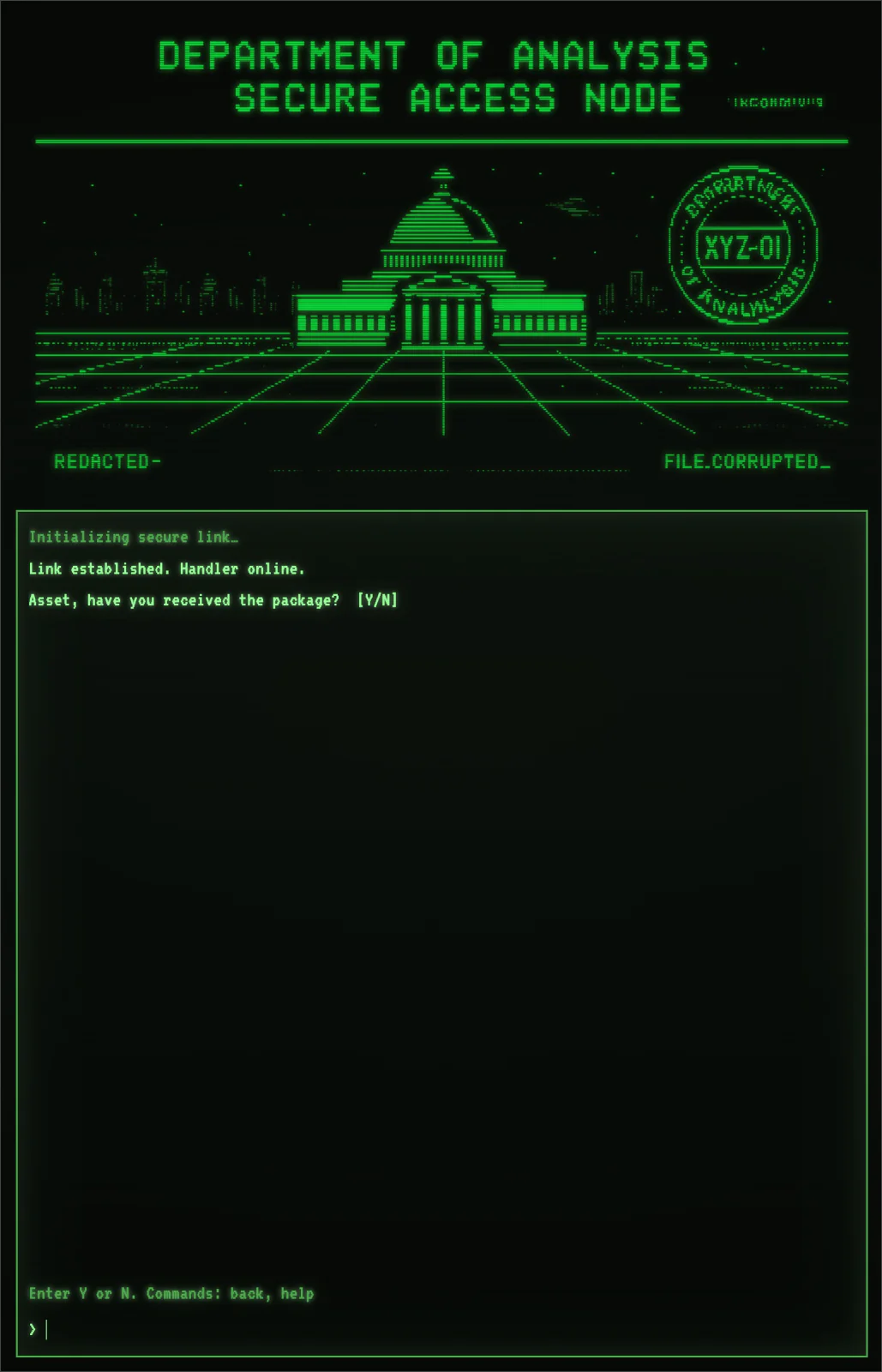
Once the mailer assembly line was running, I wanted a feedback channel that matched the rest of the bit. I sketched a CRT terminal session, talked it through, and had the form built and live inside a day. It nailed the brief on the first pass: green on black, scanlines, input fields styled as command prompts. I added a header I'd made in MidJourney, an Apple II, Oregon Trail style pixel rendering of the U.S. Capitol, and the package came together. Secret decoder ring energy, minus the Ovaltine.
The URL is just whatever Netlify provisioned. It read so cryptic and meaningless next to everything else that I never replaced it. The 80s framing earns its place, too. The game pulls from the entire UFO lore timeline without bothering to honor when any of it happened, and a vintage interface makes the nonsense feel more real.
The art
Fifty-eight original illustrations in a consistent style. Two months of bedside-laptop nights, roughly fifteen rejected images for every keeper, and one to two hours per finished card. No SREF codes, because I hadn't built that tool yet.
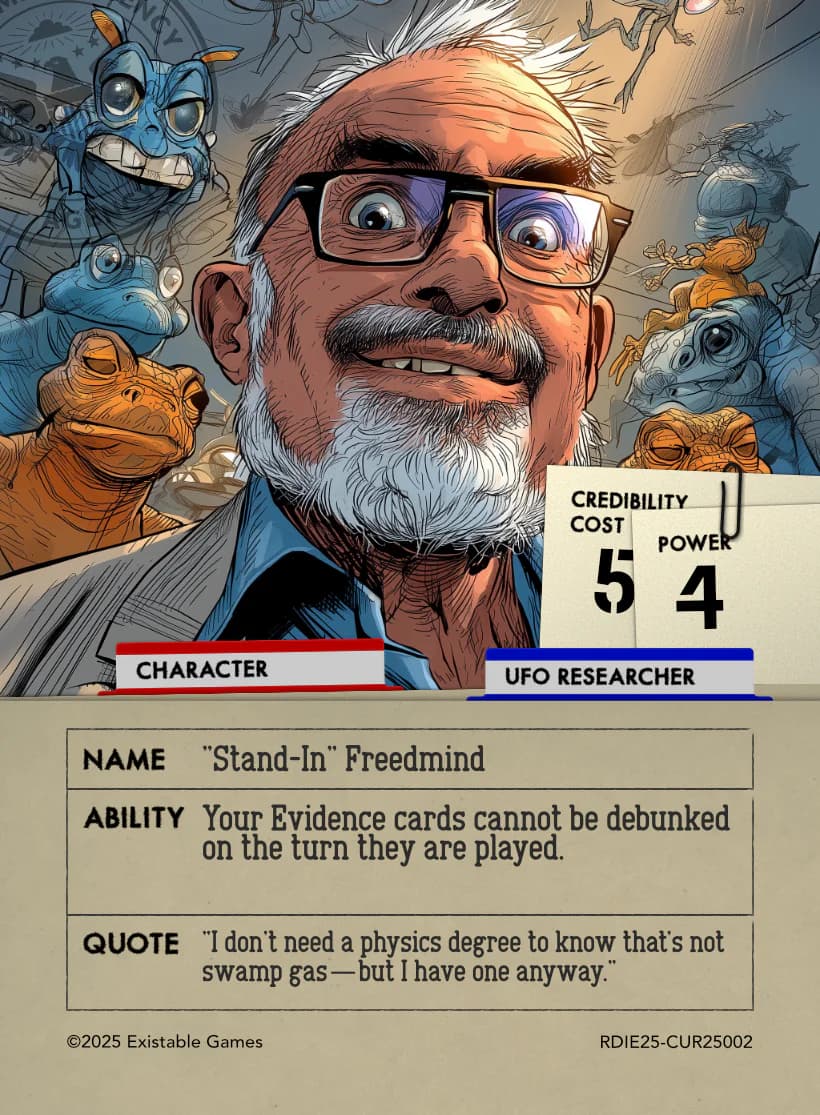
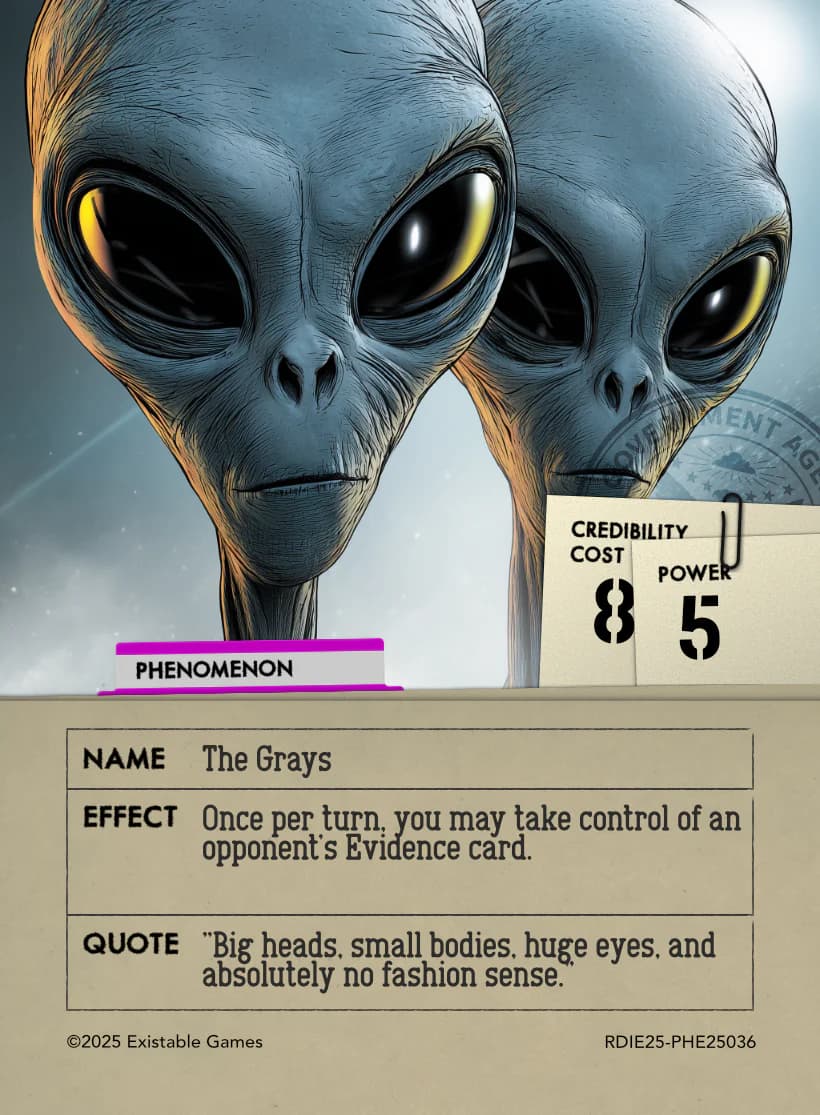
The visual direction was 90s Image Comics. Think Gen 13 and Spawn, all saturation and silhouette. I wrote prompts through a custom GPT I'd set up for the project, supplied reference photos where the satire needed them, and ran the iterations. A fair amount of the art got reworked once the card template constraints came into focus, so what shipped is the third or fourth pass on most cards.
I now have at least three SREF codes saved in SMC that would land this style in days instead of months. The gap between this project and a Redacted started today is the cleanest before-and-after I have for what style-code discovery actually saves a designer. Keep that in mind when you get to the illustration line below. It reflects the slow way.
The half hour I never saw
Fable 5 rewrote the mechanics from the ground up, then wrote itself a Python harness so it could drive my machine and play the game against itself. Twelve hundred games in about thirty minutes. I didn't watch a single one of them.
This is the part I couldn't have done at all, at any budget available to me. You can't eyeball the balance of a card game. It's an empirical problem, and the empirical work is thousands of games. Ten playtesters over six months might have gotten me most of the way there. I had neither ten playtesters nor six months.
What I actually looked at was a blinking logo. The whole run happened in a terminal I had no window into, and it finished before I did. What came back was a report: which cards were statistically broken, which ones only felt broken, and what the numbers needed to be instead. Several cards that played perfectly well were provably busted. One I'd already written off turned out to be fine.
There's nothing to show you from that half hour, and that's exactly why it's in here. The most consequential thirty minutes of the whole project produced no artifact at all, no screen worth capturing and no craft to point at. And it moved the game further than the previous six months of me guessing.
The pivot, in the shower
I spent most of a month building an online version of the game. It worked, and it wasn't good. It was technically functional and creatively dead, and the fix, a proper animation and interaction layer in Rive, is a skill I don't have yet. I love Rive. Rive is not easy. I think I need to live inside it for about a year before it's second nature, and that's a real answer, not a dodge.
What broke the logjam was a video about where organic marketing is headed, and a plain thought: I wish I had a product ready to promote. The next morning, in the shower, it landed. I do have a product. It's a box of cards. It has been a box of cards this whole time.
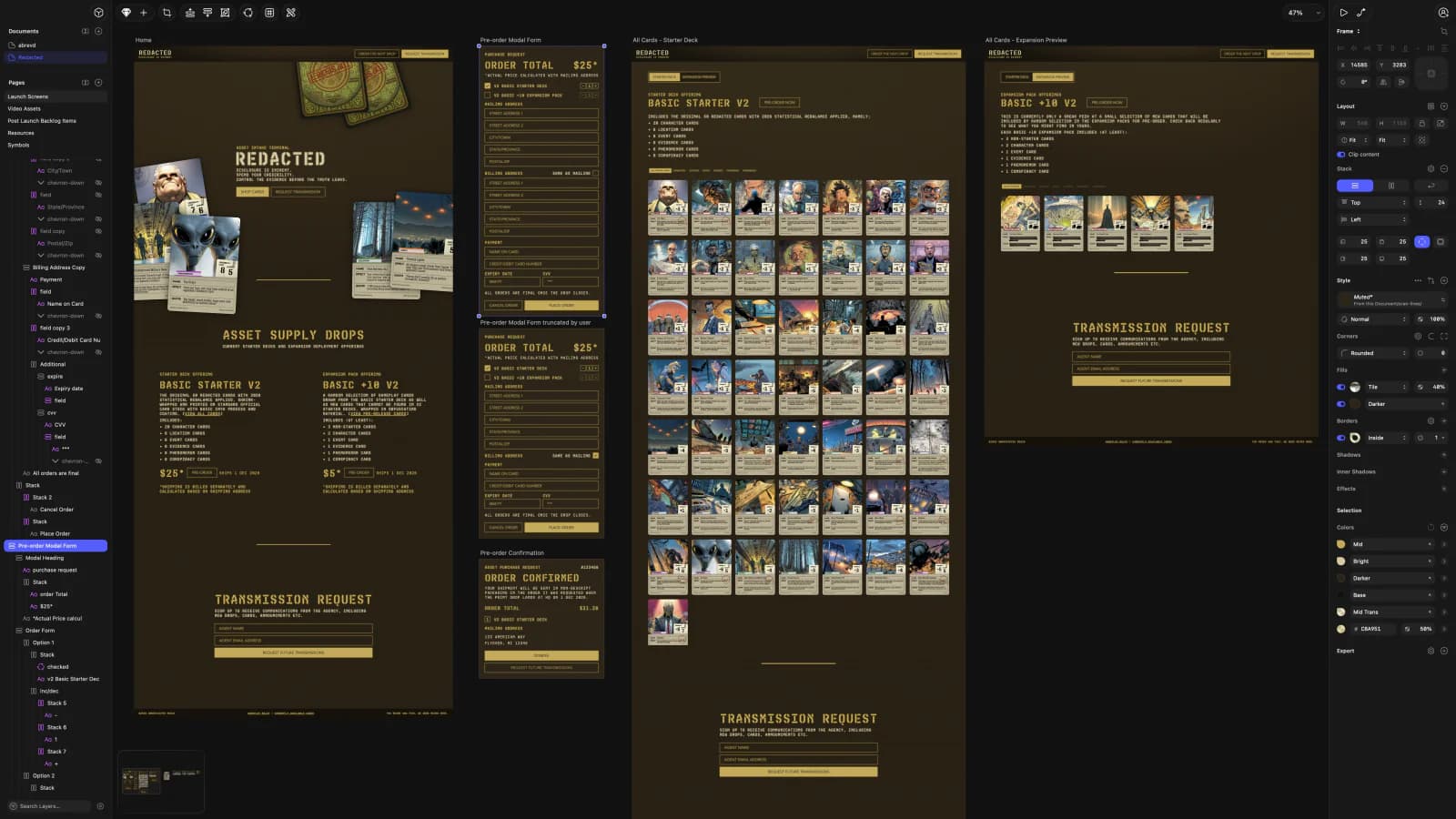
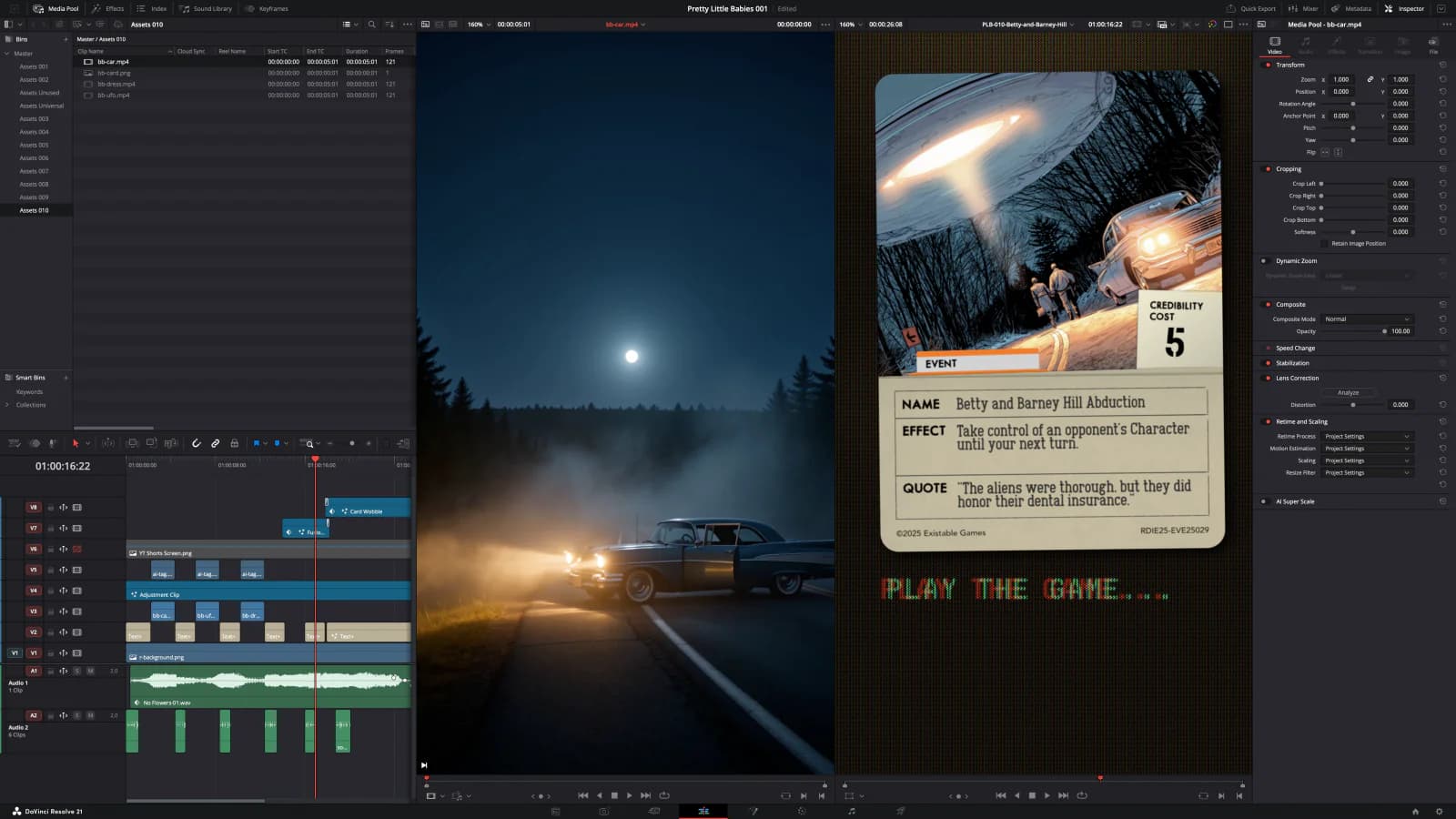
Everything since has been execution. I redrafted the print materials for the v2 rules, this time in InDesign. I designed a new drop-style storefront in Sketch and built it in Cursor with Grok 4.6, which is the closest I've come to design accuracy and idea-to-reality speed since the original Fable 5, and the reason Cursor is now my daily driver. Then a shorts template cut in DaVinci Resolve, period reenactment footage generated in Higgsfield, the first card-introduction video, Stripe, and doors open on August 25.
What a studio would have charged
I got curious about the number, so I costed it out properly: what an agency would have had to commission, at ordinary professional rates, to produce everything that's actually in this box. I kept the ranges conservative on purpose. A defensible number makes a better argument than a dramatic one.
| Line item | Low | Mid | High |
|---|---|---|---|
| Illustration, 58 cards ($150–700 per card is the professional CCG range) | $8,700 | $23,200 | $40,600 |
| Game design: rules, mechanics, balance, revisions (150–300 hours) | $10,000 | $20,000 | $35,000 |
| Graphic design: 6 templates, 50 layouts, print prep (100–150 hours) | $8,000 | $12,000 | $18,000 |
| Brand identity: logo, seal, card back, palette | $5,000 | $8,000 | $15,000 |
| Copywriting: rules text, 50 cards, marketing (50–80 hours) | $3,000 | $5,000 | $8,000 |
| Web: 3 iterations, feedback form, Stripe | $8,000 | $14,000 | $25,000 |
| Research and fact-checking: 29 sourced incidents | $8,000 | $12,000 | $18,000 |
| Video: 30 spots, three clips each | $40,000 | $60,000 | $90,000 |
| Music: custom campaign track | $500 | $1,500 | $3,000 |
| Project management and agency overhead, 15% | $13,700 | $23,400 | $37,900 |
| Total to commission | ~$105,000 | ~$179,000 | ~$290,000 |
What it actually cost
Here's the real spend. I've pro-rated the subscriptions, because most of them were doing other work at the same time, and in several of those months I was on a pricier tier than Redacted needed. These are the figures had this been the only thing on the account.
| Line item | Spend |
|---|---|
| Manus, 3 months | $240 |
| Subframe, 3 months | $240 |
| Grok via X Pro, 3 months | $100 |
| MidJourney, 3 months | $90 |
| ChatGPT Pro, 6 months | $120 |
| Claude Pro, 14 months | $280 |
| Beta print run, 10 decks from MakePlayingCards | $400 |
| Envelopes and postage | A gift from my wife |
| Total | $1,470 |
That's tooling and materials only. The storefront runs on a free hosting tier, the domain is a rounding error, and Stripe only takes its cut when something sells. What the table leaves out is my time, and that's the omission that matters.
What the number doesn't say
A case study that admits its limits is more convincing than one that doesn't, so here are the four things a skeptical reader would say next. They're all fair.
AI didn't replace the 600 hours. It replaced the specialists, not the work. Every prompt, every rejected take, and every rules revision was still a person deciding. Fifteen images in the bin for every one that shipped isn't a machine doing my job. It's me doing my job with a very fast, very tireless assistant that has no taste of its own.
Not every line is like for like. The illustrations are good and consistent, but a named CCG illustrator brings authorship and an audience that a generated set doesn't. That's a real difference in what you'd be buying.
Some things didn't compress at all. Playtesting with real humans, physical fulfillment, forming a business, the IRS, and actually mailing padded envelopes to strangers. None of it moved an inch.
Replacement cost isn't market value. $180,000 is what it would cost to commission this, not what it's worth, and certainly not what it'll earn. I'd rather say that myself than have someone say it for me.
One person, a lot of seats
Most people using these tools well are using them in one lane. A developer who writes code faster, a designer who ideates faster, a marketer who drafts faster. That's worth real money, and I'm not dismissing it. But it isn't what happened here. Over two years this project went through product research, game design, illustration, brand, print production, packaging, distribution, web development, e-commerce, fact-checking, scriptwriting, video, and music, and every one of those seats was filled the same way: by someone with thirty years of opinions about what good looks like, directing tools that had none.
That's why it reads as designed and not generated. It's taste applied across thousands of small decisions. Which of fifteen images, which of four card directions, when the online game wasn't working, and when to stop building and ship the box. The tools didn't supply any of that, and they still can't. What they supplied was the ability to act on it without a studio behind me.
Which is, conveniently, the thing I do for other people.
The doors are open at redacted.cx. Starter decks and expansions are on pre-order, shipping December 1, 2026, and the cards are going up one at a time on @Redacted-Game between now and then.